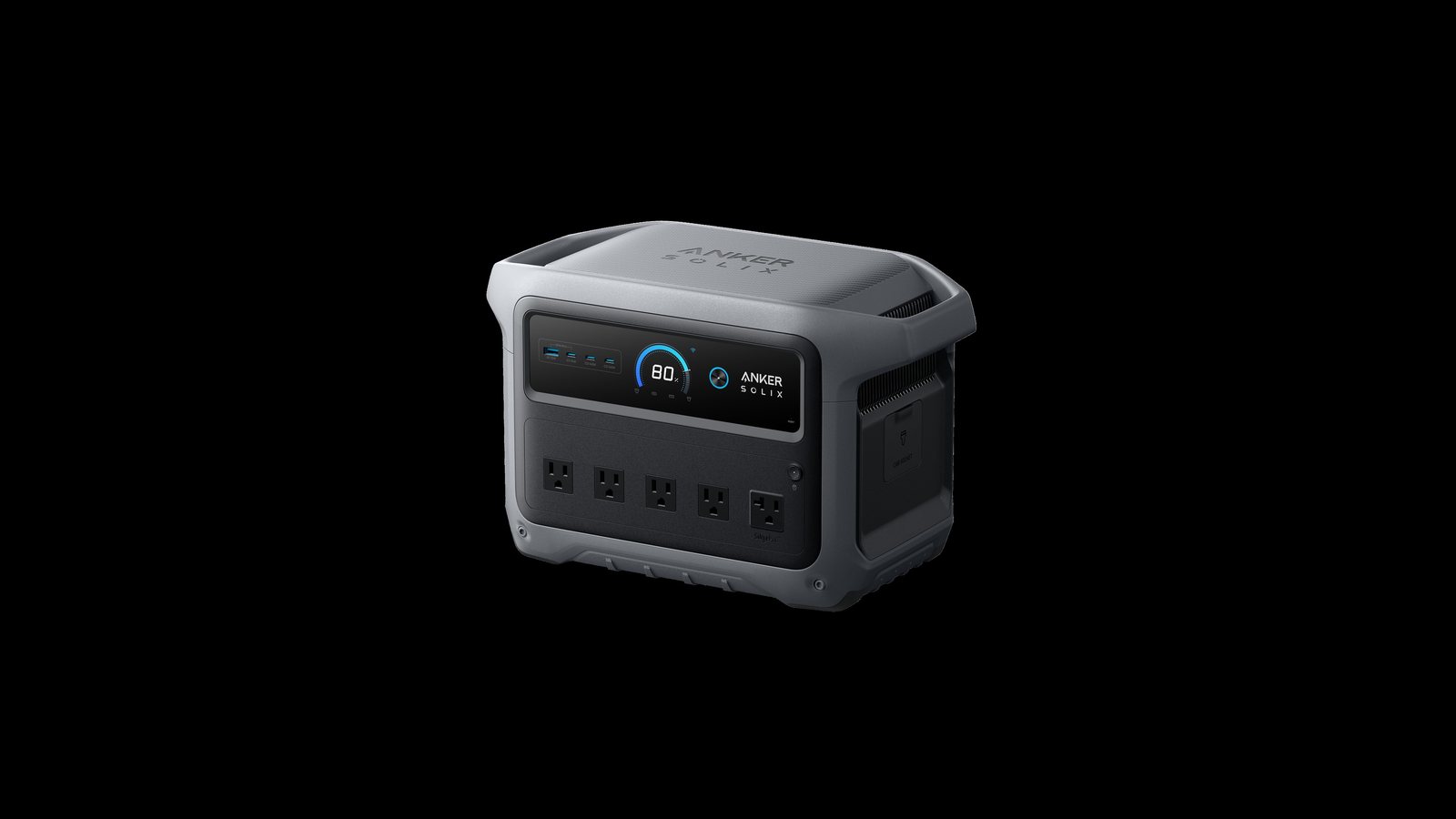
Anker SOLIX Portable Power Station Prices: $0.35/Wh, One 240V Catch
Oct. 2026: the S2000 two-pack is $0.35 per watt-hour after coupon. How to read the Halloween offers, and the F3000's 240V catch to check before you buy.
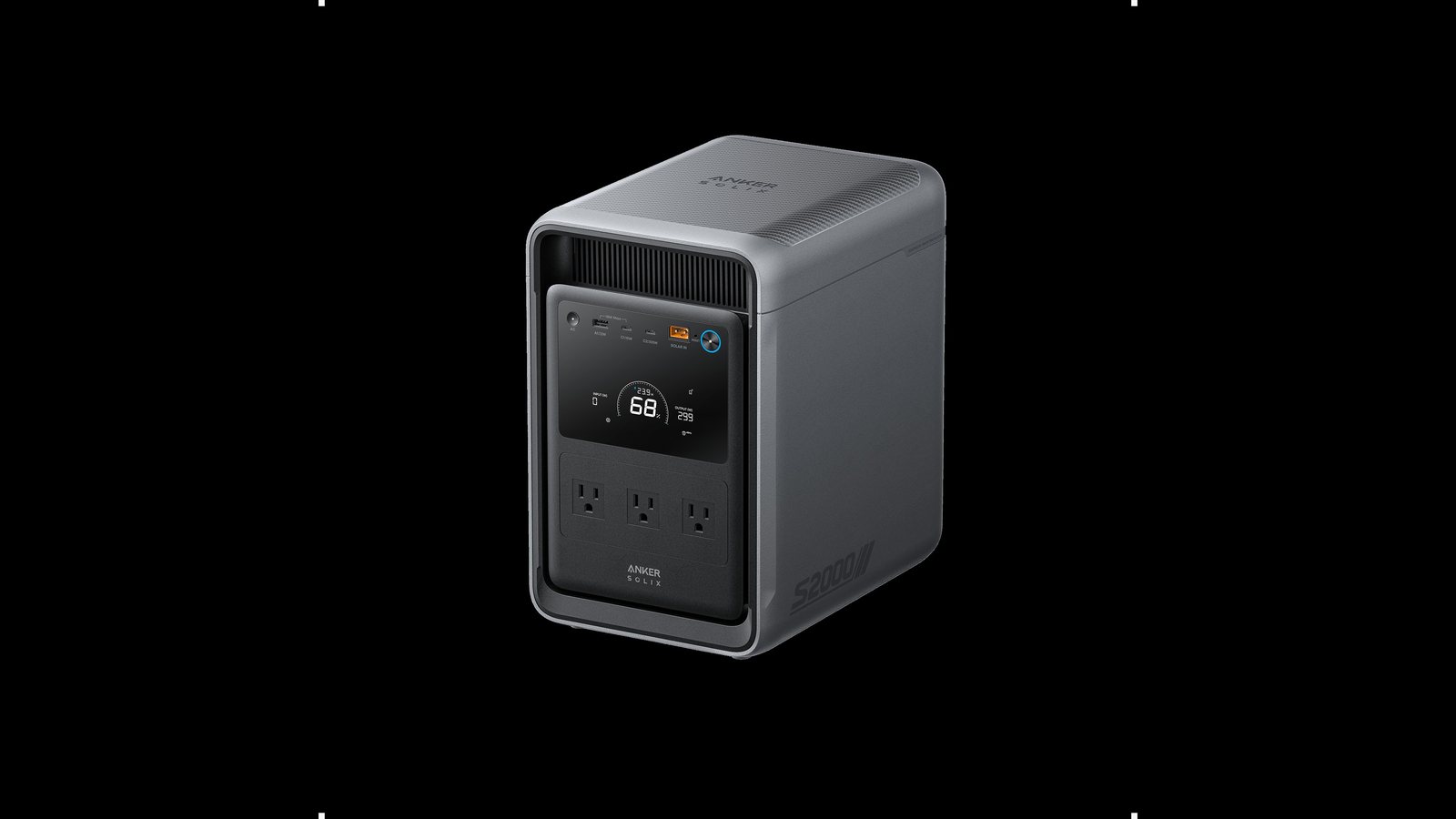
The S2000 two-pack costs $0.35 per watt-hour after coupon.
That is the clearest rate you can work out from Anker’s own pages for an Anker SOLIX portable power station.
The S2000 two-pack works out to $0.35 per watt-hour after coupon
Anker’s homepage lists two S2000 units (4,020 Wh between them) at $1,399.99 after coupon, and one S2000 at $699.99 after coupon. It gives the S2000’s UPS switchover as 10 milliseconds and promises “Up to 35 Hours of Fridge Backup.” Both are Anker’s own figures. The same page calls the new S5000 “The Longest-Lasting 5kWh Portable Power Station.”
| S2000 option | Battery capacity | AC output (Anker’s label) | Price after coupon, Oct. 23, 2026 | Price per Wh |
|---|---|---|---|---|
| One unit | 4,020 ÷ 2 = 2,010 Wh | 1,500W, 3,000W peak | $699.99 | $699.99 ÷ 2,010 Wh = $0.35 |
| Two-pack | 4,020 Wh for the pair | 1,500W each, 3,000W peak | $1,399.99 | $1,399.99 ÷ 4,020 Wh = $0.35 |
| Two single units | 4,020 Wh | 1,500W each, 3,000W peak | 2 × $699.99 = $1,399.98 | $1,399.98 ÷ 4,020 Wh = $0.35 |
Three things no single Anker page spells out:
- The two-pack carries no bulk discount. Two singles cost one cent less than the pack.
- “AC output” is not labeled continuous. Only the S2000 splits its rating into 1,500W and a 3,000W peak. Treat the C2000 Gen 2’s 2,400W (collection page) and the F3000’s 3,600W as headline figures. Find the continuous number on each product page before you size a load.
- Runtime at full load is short. At the F3000’s full 3,600W, 3,072 Wh ÷ 3,600 W = 0.85 hours (F3000 page). That’s about 51 minutes, before conversion losses. One expansion battery adds 6,144 − 3,072 = 3,072 Wh, which doubles it.
The C2000 Gen 2 takes 800W of solar, a third of the F3000’s input
The power stations collection page lists the C2000 Gen2 at 2,400W AC output, 800W solar input and an 1,800W/120V generator bypass. Bypass is the load it can pass from a generator straight to your devices, and only at 120V.
Its weak spot is the solar limit. 800W ÷ 2,400W means it takes one third of the solar power the F3000 accepts. If you plan a large panel array for long outages, skip the C2000 Gen 2 and choose the F3000, which takes 2,400W over two PV inputs.
The F3000 is 120V on its own; 240V needs two units and a hub
The F3000 product page says one F3000 gives only 120V. To get 240V, you connect two F3000s through a double voltage hub. That matters if your outage plan includes a 240V appliance such as a well pump or an electric dryer. If it does, skip the F3000 and look at the F3800 Plus, which the collection page lists at 6,000W with 240V.
Here’s what you get in return:
- Two PV inputs that together take up to 2,400W of solar.
- A TOU (time-of-use) mode that charges when grid power is cheap and supplies power when it is expensive. Anker’s page ties storing off-peak power to the optional Power Saver Kit, sold separately.
- Low idle draw. Anker claims “up to 5 days of AC standby or 2 days of cooling an 8 cu.ft fridge.”
- 6,000W of combined generator-plus-solar recharge, but only with an expansion battery attached.
- Two different solar-charge times on the same page: “fully charging in under 2 hours with optimal sunlight” and “Full Power in Just 1.5 Hours.” For rough scale, 3,072 Wh ÷ 2,400 W = 1.28 hours at the full solar input, before charging losses.
- A capacity ceiling of “24kWh.” That is 24,000 ÷ 3,072 = about 7.8 times the base unit.
The Halloween sale: check the coupon price; gifts and installments leave the price alone
The homepage runs the Halloween sale from Oct. 23 to Nov. 1. It stacks four kinds of offer, and only some of them lower what you pay:
- “After Coupon” prices. This is what you pay at checkout, such as the S2000 at $699.99. To see what the coupon saves, compare it with the price shown before the coupon applies.
- “Free Gifts and Halloween Savings of Up to $2,200 Off.” “Up to” is a ceiling, and the line mixes gifts with savings. It is not the saving on every model.
- “Up to $2,767 in Free Gifts.” The banner ties this to the “E10 Halloween Sale,” and Anker sets the gift value. Gifts lower your cost only for items you would have bought anyway.
- 60 monthly installments. Spreading a price over 60 payments does not lower it. The banner gives the number of payments but no interest rate, so read the financing terms before you sign. This is general information, not financial advice.
The S5000 offer is separate. The homepage lists “Sign-Up Perks Worth $1,799” for early access, and it “Ends Oct. 26.” That is a value Anker puts on the perks, not a price for the 5kWh unit.
The real test comes after Nov. 1. If the same price is still there once the coupon ends, the “sale” was just the new normal price. The power station price ledger reads the C1000X and F3800 Plus prices from Anker’s store every day and logs the day either one moves. To run the same check on other brands, see WattPriced’s power station prices and sales.
UL 2743 covers battery power packs; the CPSC labeling rule covers engine generators
UL 2743 is the safety standard for portable power packs. It covers the parts inside, including “inverters, vehicle adapters, and internal batteries,” and the charging of those batteries. It does not cover lithium-ion or sodium-ion packs above 20 kWh. Those fall under UL 9540. Two F3000 facts sit next to that line: its page title reads “UL9540 Certificated,” and Anker says it is “expandable to 24kWh.” Check which standard each unit’s page names instead of assuming one.
16 CFR Part 1407 is the CPSC’s labeling rule for portable generators. It defines one as a generator driven by an internal combustion engine and rated no higher than 15 kW and 250 volts. A battery power station has no engine, so it falls outside that definition. A gas generator you pair with the F3000’s combined recharge or the C2000 Gen 2’s bypass falls under the rule if it meets that definition.
The federal Residential Clean Energy Credit ended after 2025
The IRS page says the Residential Clean Energy Credit is not available for property placed in service after December 31, 2025. A unit you put into use in 2026 falls after that date, so leave a federal credit out of its cost. This is general information, not tax advice.
On these pages, the F3000’s TOU mode is the remaining way to cut running costs. It shifts charging to cheap hours and use to expensive ones. Anker ties storing off-peak power to the optional Power Saver Kit, sold separately. What it saves depends on the gap between your utility’s cheap and expensive rates.
Buy the F3000 for 120V backup you can grow; skip it if one unit must give 240V
The F3000’s biggest flaw is voltage. One unit gives only 120V, and getting 240V means buying a second F3000 plus a double voltage hub, per the F3000 page. Its 6,000W combined recharge also needs an expansion battery. But it takes 2,400W of solar, three times the C2000 Gen 2’s 800W. It also grows from 3,072 Wh to 6,144 Wh with one expansion battery, and Anker says up to 24kWh. Buy it if your backup plan runs on 120V circuits and you want to add capacity over time.
If you want the lowest dated cost per watt-hour, choose the S2000, and accept that its 1,500W is the lowest output figure here. If you want 5kWh in one box, the S5000 fits, but first get its wattage and price from its product page.
FAQ
What does an Anker SOLIX power station cost per watt-hour?
The S2000 comes to about 35 cents per watt-hour after coupon as of Oct. 23, 2026, whether you buy one or the two-pack.
Is the S5000’s $1,799 offer part of the Halloween sale?
No. The homepage lists it as early-access sign-up perks that end Oct. 26. The Halloween sale runs Oct. 23 to Nov. 1.
Does a power station put into use in 2026 get the federal clean energy credit?
No. The IRS says that credit is not available for property placed in service after December 31, 2025.
Sources
- https://www.ankersolix.com/products/f3000
- https://www.ankersolix.com/
- https://www.ecfr.gov/current/title-16/chapter-II/subchapter-B/part-1407
- https://www.shopulstandards.com/ProductDetail.aspx?productId=UL2743
- https://www.irs.gov/credits-deductions/residential-clean-energy-credit
- https://www.ankersolix.com/collections/power-stations